> ## Documentation Index
> Fetch the complete documentation index at: https://docs.appcharge.com/llms.txt
> Use this file to discover all available pages before exploring further.
# Configure Developer Settings
This article explains the technical settings required to connect your systems with Appcharge, including your project identity, credentials, callbacks, and webhooks. These settings allow your backend services to authenticate with Appcharge and receive or respond to platform events during player authentication, purchases, and other interactions.
You can also test callbacks and webhooks directly from the Publisher Dashboard. Testing sends a simulated Appcharge request or event to your endpoint so you can verify delivery and response handling before going live.
Test payloads don't represent real players or transactions and aren't validated against your business logic. Your system is responsible for validating and processing the payload appropriately.
## Get Started
To configure your Developer Settings:
1. In the Publisher Dashboard, select the project you want to configure in the **Projects** section of the sidebar menu.
2. In the sidebar menu, under **Management**, click **Settings**.
3. Make sure you're in the **Developer Settings** tab.
If the project you selected is a Web Store that has a corresponding Game Portal, you'll see a note explaining that Developer Settings are configured in the Portal Dashboard. Click **Portal Dashboard** to open and configure the Developer Settings there.
4. Review and complete the relevant sections described below.
### Project Info
View and manage your project details:
* **Project Name:** Enter or update the name of your project.
* **Project ID:** View your project ID.
* **Domain:** Enter your domain name. This field is relevant only for Appcharge Web Stores or Game Portals.
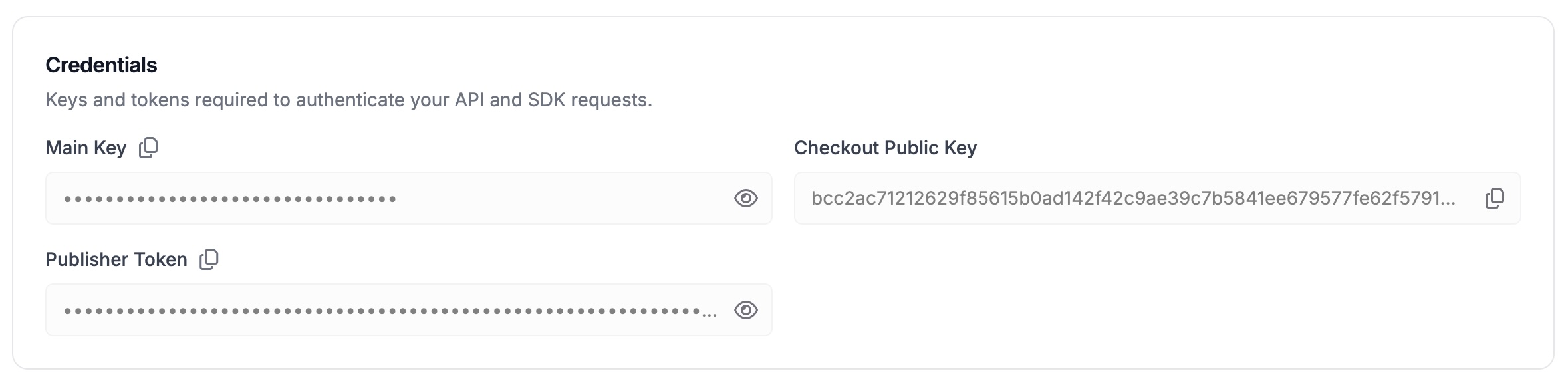
 ### Credentials
View the keys and tokens required to authenticate API, SDK, and checkout requests:
* **Main Key:**
Optional secret key used to sign and verify request payloads between your backend and Appcharge. Keep this key private and never expose it in client-side code.
For implementation details, see [Secure Communication with the Appcharge Platform](/../../merchant-of-record/security/appcharge-to-publisher-secure-communication).
* **Checkout Public Key:**
Public key used for checkout-related communication between your platform and Appcharge. This key can be safely embedded in frontend code. Relevant only for external web stores using Appcharge Checkout or Payment Links.
* **Publisher Token:**
Token used to authenticate your system when calling Appcharge APIs, as well as for securing webhooks and callbacks.
### Credentials
View the keys and tokens required to authenticate API, SDK, and checkout requests:
* **Main Key:**
Optional secret key used to sign and verify request payloads between your backend and Appcharge. Keep this key private and never expose it in client-side code.
For implementation details, see [Secure Communication with the Appcharge Platform](/../../merchant-of-record/security/appcharge-to-publisher-secure-communication).
* **Checkout Public Key:**
Public key used for checkout-related communication between your platform and Appcharge. This key can be safely embedded in frontend code. Relevant only for external web stores using Appcharge Checkout or Payment Links.
* **Publisher Token:**
Token used to authenticate your system when calling Appcharge APIs, as well as for securing webhooks and callbacks.
 ### Callbacks
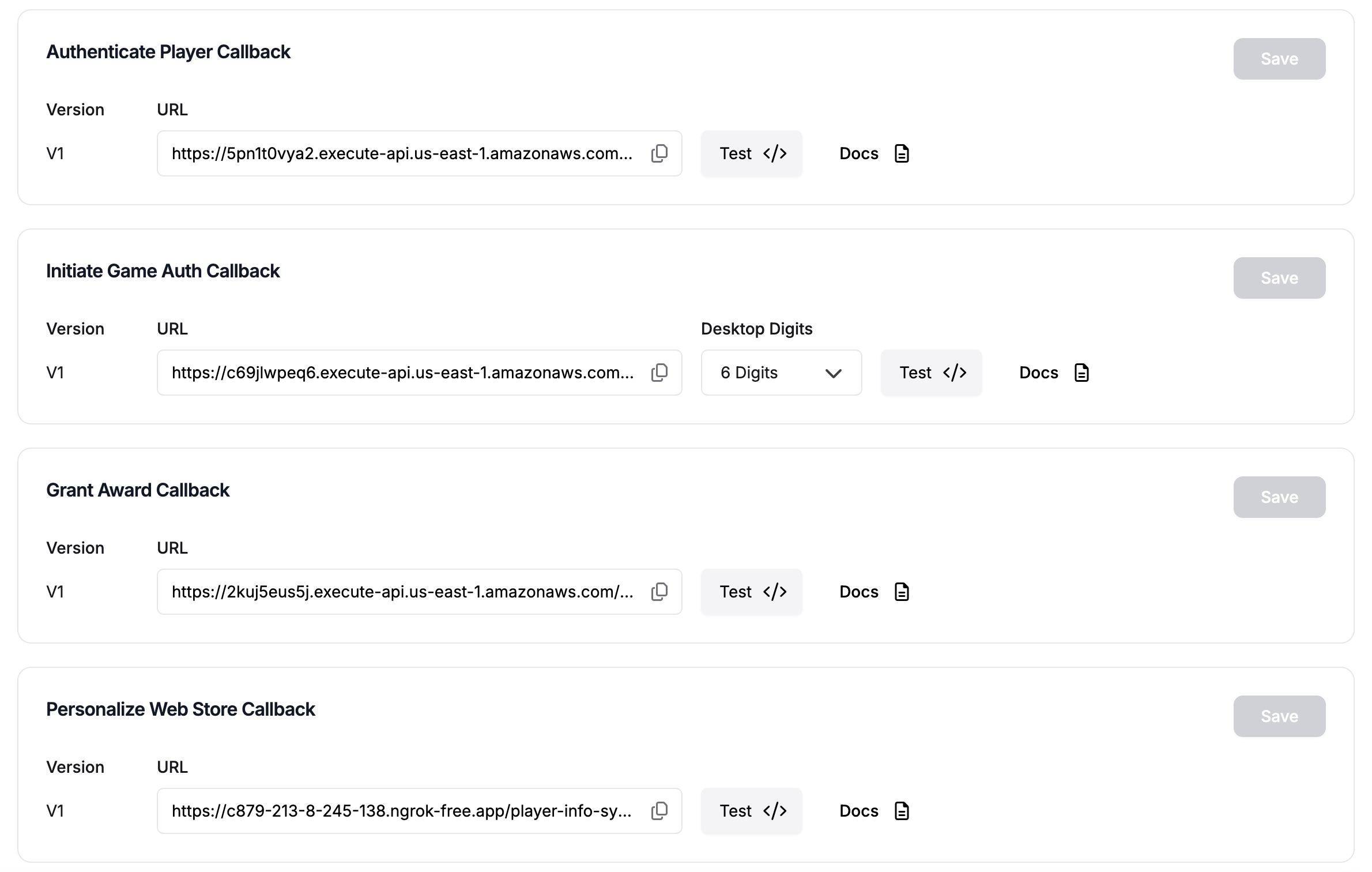
Callbacks allow Appcharge to communicate with your backend systems. They are synchronous requests that require an immediate response from your system during a user flow. For example, when authenticating a player.
To implement a callback, create and expose a publicly accessible HTTPS endpoint that follows the structure defined in the documentation. When Appcharge calls the configured endpoint, it instructs your system to perform a specific action.
Each callback can be configured and tested directly from the Publisher Dashboard before going live.
This callback is relevant only for Appcharge Web Stores, Game Portals, and Parking Domains.
To configure and test the callback:
1. Enter your endpoint URL in the **URL** field, and then click **Save**.
2. Click **Docs** to view the available callback fields and their definitions. You can refer to this documentation while testing the callback.
3. Click **Test** to open the test configuration panel.
4. Use the **Hide optional fields** checkbox to simplify the payload view. You can uncheck it at any time to include optional properties in your test.
5. In the **Player Authentication Method** drop-down menu, select the player authentication method you want to test. The available fields update dynamically based on the selected authentication type.
6. Customize the test payload by editing required and optional properties. Use these fields to simulate different player authentication methods and validate your endpoint’s behavior.
7. In the top-right corner, click:
* **Test** to send the request directly from the Publisher Dashboard, or
* **Copy cURL** to run the request externally.
8. Verify that your endpoint returns the expected HTTP status code and response body.
This callback is relevant only when implementing Game Redirect Login for Appcharge Web Stores and Game Portals. [Set up Game Redirect Login](/../../webstore/player-authentication/game-redirect-login/set-up-game-redirect-login).
To configure and test the callback:
1. Enter your endpoint URL in the **URL** field, and then click **Save**.
2. Click **Docs** to view the available callback fields and their definitions. You can refer to this documentation while testing the callback.
3. Click **Test** to open the test configuration panel.
4. Use the **Hide optional fields** checkbox to simplify the payload view. You can uncheck it at any time to include optional properties in your test.
5. In the **Desktop Digits** drop-down menu, select one of the following:
* **4 Digits:** Generates a 4-digit authentication code.
* **6 Digits:** Generates a 6-digit authentication code.
* **Mobile Only:** Enables authentication for mobile devices only.
6. Customize the test payload by editing required and optional properties. Use these fields to simulate different devices and validate your endpoint’s behavior.
7. In the top-right corner, click:
* **Test** to send the request directly from the Publisher Dashboard, or
* **Copy cURL** to run the request externally.
8. Verify that your endpoint returns the expected HTTP status code and response body.
To configure and test the callback:
1. Enter your endpoint URL in the **URL** field, and then click **Save**.
2. Click **Docs** to view the available callback fields and their definitions. You can refer to this documentation while testing the callback.
3. Click **Test** to open the test configuration panel.
4. Use the **Hide optional fields** checkbox to simplify the payload view. You can uncheck it at any time to include optional properties in your test.
5. Customize the test payload by editing required and optional properties. Use these fields to simulate the purchase or collection of an offer in your checkout and validate your endpoint’s behavior.
6. In the top-right corner, click:
* **Test** to send the request directly from the Publisher Dashboard, or
* **Copy cURL** to run the request externally.
7. Verify that your endpoint returns the expected HTTP status code and response body.
This callback is relevant only if you choose to implement real-time personalization for your Appcharge Web Store.
To configure and test the callback:
1. Enter your endpoint URL in the **URL** field, and then click **Save**.
2. Click **Docs** to view the available callback fields and their definitions. You can refer to this documentation while testing the callback.
3. Click **Test** to open the test configuration panel.
4. Use the **Hide optional fields** checkbox to simplify the payload view. You can uncheck it at any time to include optional properties in your test.
5. Customize the test payload by editing required and optional properties. Use these fields to simulate different players and validate your endpoint’s behavior.
6. In the top-right corner, click:
* **Test** to send the request directly from the Publisher Dashboard, or
* **Copy cURL** to run the request externally.
7. Verify that your endpoint returns the expected HTTP status code and response body.
### Callbacks
Callbacks allow Appcharge to communicate with your backend systems. They are synchronous requests that require an immediate response from your system during a user flow. For example, when authenticating a player.
To implement a callback, create and expose a publicly accessible HTTPS endpoint that follows the structure defined in the documentation. When Appcharge calls the configured endpoint, it instructs your system to perform a specific action.
Each callback can be configured and tested directly from the Publisher Dashboard before going live.
This callback is relevant only for Appcharge Web Stores, Game Portals, and Parking Domains.
To configure and test the callback:
1. Enter your endpoint URL in the **URL** field, and then click **Save**.
2. Click **Docs** to view the available callback fields and their definitions. You can refer to this documentation while testing the callback.
3. Click **Test** to open the test configuration panel.
4. Use the **Hide optional fields** checkbox to simplify the payload view. You can uncheck it at any time to include optional properties in your test.
5. In the **Player Authentication Method** drop-down menu, select the player authentication method you want to test. The available fields update dynamically based on the selected authentication type.
6. Customize the test payload by editing required and optional properties. Use these fields to simulate different player authentication methods and validate your endpoint’s behavior.
7. In the top-right corner, click:
* **Test** to send the request directly from the Publisher Dashboard, or
* **Copy cURL** to run the request externally.
8. Verify that your endpoint returns the expected HTTP status code and response body.
This callback is relevant only when implementing Game Redirect Login for Appcharge Web Stores and Game Portals. [Set up Game Redirect Login](/../../webstore/player-authentication/game-redirect-login/set-up-game-redirect-login).
To configure and test the callback:
1. Enter your endpoint URL in the **URL** field, and then click **Save**.
2. Click **Docs** to view the available callback fields and their definitions. You can refer to this documentation while testing the callback.
3. Click **Test** to open the test configuration panel.
4. Use the **Hide optional fields** checkbox to simplify the payload view. You can uncheck it at any time to include optional properties in your test.
5. In the **Desktop Digits** drop-down menu, select one of the following:
* **4 Digits:** Generates a 4-digit authentication code.
* **6 Digits:** Generates a 6-digit authentication code.
* **Mobile Only:** Enables authentication for mobile devices only.
6. Customize the test payload by editing required and optional properties. Use these fields to simulate different devices and validate your endpoint’s behavior.
7. In the top-right corner, click:
* **Test** to send the request directly from the Publisher Dashboard, or
* **Copy cURL** to run the request externally.
8. Verify that your endpoint returns the expected HTTP status code and response body.
To configure and test the callback:
1. Enter your endpoint URL in the **URL** field, and then click **Save**.
2. Click **Docs** to view the available callback fields and their definitions. You can refer to this documentation while testing the callback.
3. Click **Test** to open the test configuration panel.
4. Use the **Hide optional fields** checkbox to simplify the payload view. You can uncheck it at any time to include optional properties in your test.
5. Customize the test payload by editing required and optional properties. Use these fields to simulate the purchase or collection of an offer in your checkout and validate your endpoint’s behavior.
6. In the top-right corner, click:
* **Test** to send the request directly from the Publisher Dashboard, or
* **Copy cURL** to run the request externally.
7. Verify that your endpoint returns the expected HTTP status code and response body.
This callback is relevant only if you choose to implement real-time personalization for your Appcharge Web Store.
To configure and test the callback:
1. Enter your endpoint URL in the **URL** field, and then click **Save**.
2. Click **Docs** to view the available callback fields and their definitions. You can refer to this documentation while testing the callback.
3. Click **Test** to open the test configuration panel.
4. Use the **Hide optional fields** checkbox to simplify the payload view. You can uncheck it at any time to include optional properties in your test.
5. Customize the test payload by editing required and optional properties. Use these fields to simulate different players and validate your endpoint’s behavior.
6. In the top-right corner, click:
* **Test** to send the request directly from the Publisher Dashboard, or
* **Copy cURL** to run the request externally.
7. Verify that your endpoint returns the expected HTTP status code and response body.
 ### Webhooks
Webhooks allow your systems to receive notifications when specific events occur in your Appcharge products.
Unlike callbacks, webhooks are asynchronous. Appcharge sends the event after the action occurs, and your system processes it independently.
To use a webhook, create and expose a publicly accessible HTTPS endpoint that can receive event notifications and process them according to the webhook schema defined in the documentation.
Configure and test the webhook directly from the Publisher Dashboard before going live:
To configure and test the webhook:
1. Enter your endpoint URL in the **URL** field, and then click **Save**.
2. Click **Docs** to view the event schema and field descriptions for the events you want to test. Refer to this documentation while testing different event types.
3. Click **Test** to open the test configuration panel.
4. Use the **Hide optional fields** checkbox to simplify the payload view. You can uncheck it at any time to include optional properties in your test.
5. In the **Event Name** drop-down menu, select the event you want to test. The available fields update dynamically based on the selected event type.
6. Customize the test payload by editing the event's properties. Modify required and optional fields to simulate different scenarios and validate how your endpoint handles various webhook payloads.
7. In the top-right corner, click:
* **Test** to send the event directly from the Publisher Dashboard, or
* **Copy cURL** to run the request externally.
8. Verify that your webhook endpoint receives the event and returns the expected response.
### Webhooks
Webhooks allow your systems to receive notifications when specific events occur in your Appcharge products.
Unlike callbacks, webhooks are asynchronous. Appcharge sends the event after the action occurs, and your system processes it independently.
To use a webhook, create and expose a publicly accessible HTTPS endpoint that can receive event notifications and process them according to the webhook schema defined in the documentation.
Configure and test the webhook directly from the Publisher Dashboard before going live:
To configure and test the webhook:
1. Enter your endpoint URL in the **URL** field, and then click **Save**.
2. Click **Docs** to view the event schema and field descriptions for the events you want to test. Refer to this documentation while testing different event types.
3. Click **Test** to open the test configuration panel.
4. Use the **Hide optional fields** checkbox to simplify the payload view. You can uncheck it at any time to include optional properties in your test.
5. In the **Event Name** drop-down menu, select the event you want to test. The available fields update dynamically based on the selected event type.
6. Customize the test payload by editing the event's properties. Modify required and optional fields to simulate different scenarios and validate how your endpoint handles various webhook payloads.
7. In the top-right corner, click:
* **Test** to send the event directly from the Publisher Dashboard, or
* **Copy cURL** to run the request externally.
8. Verify that your webhook endpoint receives the event and returns the expected response.
